

Alloy Wheel
Welding Manchester
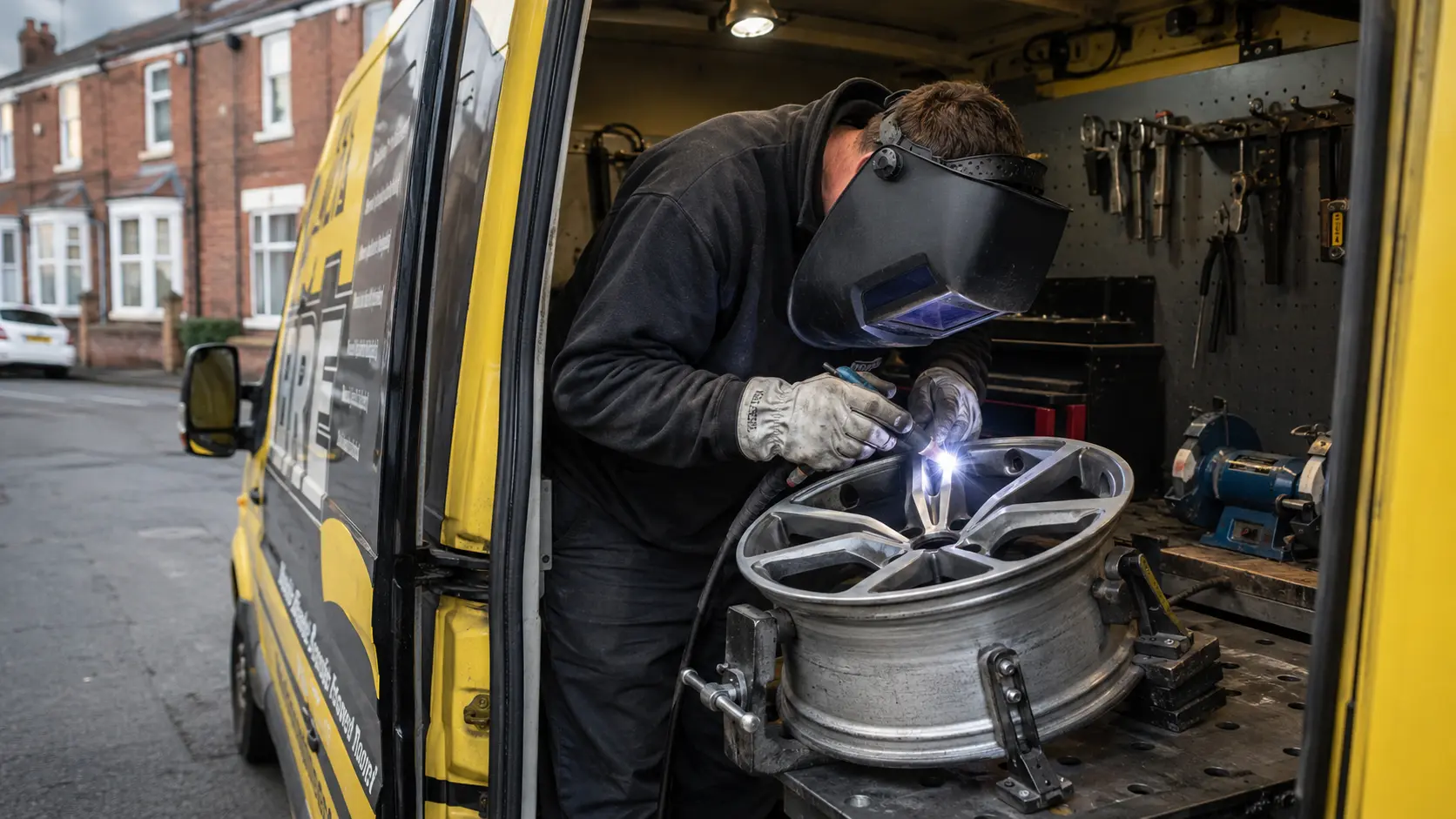
Cracked alloy wheel? We perform professional TIG welding on cracked rims — structural repair, pressure tested, same-day service. Workshop and mobile options available across Manchester.
Our Alloy Welding Service
- Structural TIG welding for cracked alloy wheels
- Inner rim barrel & lip crack repair
- Stop-drilling & deep V-groove preparation
- AC/DC TIG welding with matching filler rods
- Full dye penetrant crack inspection
- Pressure tested & balanced
- Workshop & mobile service available
- Same-day turnaround (1–2 hours)
- Honest assessment — safe repair or replace?
Alloy Wheel Welding Pricing — Manchester
Pricing depends on crack length, location, and whether the wheel has been previously repaired. We quote after inspecting a photo — no surprises.
Hairline Crack
Small inner barrel or lip crack. Quick single-pass weld, minimal preparation. Same-day.
Deep Crack
Longer crack on inner barrel requiring V-groove prep and multi-pass weld. Structural strength restored.
Complex Repair
Extensive damage, multiple cracks, or previous poor repairs. Full structural restoration required.
Send a photo on WhatsApp for an accurate quote before we book you in. Final price confirmed on inspection.
What Alloy Wheel Cracks Can Be Welded?
Not every crack can be safely welded. Here is our definitive guide on what we can and cannot repair.
✅ Safe to Weld
- Inner rim barrel cracks (most common)
- Rim lip cracks (bead seat area)
- Hairline cracks under 2 inches
- Cracks running perpendicular to the lip
- Single crack (not multiple fractures)
- Face cracks on non-structural sections
❌ Not Safe to Weld
- Spoke cracks (dynamic load bearing)
- Central hub mounting face cracks
- Multiple cracks on the same wheel
- Cracks longer than 2 inches in high-stress zones
- Cracks running through structural load points
- Wheels with previous failed repairs
We inspect every wheel individually. If we cannot weld it safely, we will tell you honestly. Your safety always comes first.
Why Choose O&A Tyres For Alloy Wheel Welding?
We are one of the few workshops in Manchester with specialist AC/DC TIG welding capability and structural repair expertise.
🔧 TIG Welding Specialist
Professional AC/DC TIG equipment with aluminium-magnesium filler rods that match OEM tensile strengths. We weld at 150+ Amps for deep, clean fusion — not surface patches.
🛡️ Safety-First Protocol
Every repair includes stop-drilling, deep V-groove preparation, dye penetrant inspection, and full pressure testing at operational PSI. We never compromise on safety.
⚡ Same-Day Turnaround
Emergency bookings fitted into our schedule. Most repairs are completed within 1–2 hours. Drop your wheel off and collect it ready to fit the same day.
💰 Save vs Replacement
New OEM alloy wheels cost £300–£1,000+. Our welding service starts from £50. You keep your original wheels and save hundreds of pounds.
🚐 Workshop & Mobile
We operate a professional workshop with dedicated welding facilities. We also offer a mobile service — we come to your location with our self-contained welding van.
📋 Honest Assessment
Not every crack is repairable. We inspect and give you an honest opinion — if the wheel is unsafe to weld, we’ll tell you. No unnecessary work.
Our Professional Welding Process
A structural weld requires precision metallurgical work, not just heat. Here is the step-by-step process we follow.
Inspect & Assess
We remove the tyre and run a dye penetrant test to identify the crack path, depth, and termination point with precision.
Stop-Drill & Prep
We drill a relief hole at the crack termination point and carve a deep V-groove along the fracture to expose clean, unoxidised aluminium.
TIG Weld
Using AC/DC TIG equipment, we lay structural passes from both sides using matching aluminium-magnesium filler rods for deep fusion.
Test & Balance
We grind the weld flush, pressure-test at full PSI, balance the wheel, and ensure the bead seats flawlessly.
Our Alloy Wheel Welding Services
We offer comprehensive alloy wheel welding services across Manchester.
Pothole Damage Repair
Inner barrel cracks caused by hitting a pothole at speed. The impact stress fractures the aluminium — often invisible until the tyre deflates. We weld these structural cracks safely.
Hairline Crack Repair
Your tyre keeps losing pressure but there is no nail. This is a classic hairline crack on the inner barrel. Air escapes through the fracture under load. We weld and seal it completely.
Rim Lip Crack Welding
Kerb strikes or severe impact can split the rim lip. This affects the tyre bead seal and causes vibration. We weld the lip and machine it back to spec.
Structural Crack Welding
Longer cracks (over 2 inches) or multiple fractures in the barrel. Requires multi-pass welding and careful heat management to restore full strength.
Previous Poor Repair Fix
Someone previously attempted a MIG weld or epoxy patch that failed. We grind out the bad repair, prep the metal properly, and weld it to structural standard.
⚠️ What We Cannot Weld
We do not weld spokes, the central hub mounting face, or wheels with multiple fractures in high-stress zones. We will tell you honestly if the wheel is scrap.
Areas We Cover For Alloy Wheel Welding
Workshop-based with mobile service across Manchester and surrounding areas.
Professional Alloy Wheel Welding in Manchester
Alloy wheels are made from cast aluminium alloys that are strong but brittle under impact. When you hit a pothole, kerb, or debris at speed, the sudden force can fracture the metal. The result is a crack — often invisible from the outside but weeping air through the inner barrel. A cracked wheel is dangerous because the fracture can propagate and the wheel can fail catastrophically. Professional TIG welding, executed correctly, restores structural integrity and saves you the cost of a new wheel.
At O&A Tyres, we specialise in structural alloy wheel welding using AC/DC TIG equipment. Our technicians are trained in the precise techniques required for aluminium alloy repair — stop-drilling, V-groove preparation, and multi-pass welding with matching filler rods. We serve customers across Manchester and the surrounding areas, offering both workshop-based and mobile services.
TIG Welding vs MIG Welding — Why It Matters
MIG welding applies too much heat too quickly, creating a brittle, porous weld that does not fuse properly to the parent aluminium. The heat-affected zone becomes weak and prone to cracking again within weeks. TIG welding (Tungsten Inert Gas) uses a tungsten electrode to generate precise, controlled heat. The welder can adjust amperage in real time, ensuring deep penetration without overheating the surrounding metal. For alloy wheels, AC (Alternating Current) TIG welding is essential to break through the aluminium oxide layer. We use AC/DC TIG at 150+ Amps with 1.5mm–2mm aluminium-magnesium filler rods that match OEM tensile strengths.
What Cracks Can Be Safely Welded?
Safe to weld: Inner rim barrel cracks (the most common), rim lip cracks, and some face cracks that are not on structural load-bearing sections. Cracks under 2 inches in length are generally straightforward. Longer cracks require multi-pass welding but are still repairable if the wheel is not extensively fatigued.
Not safe to weld: Spoke cracks, central hub mounting face cracks, multiple cracks on the same wheel, and any crack that runs through a high-stress structural point. In these cases, the wheel is structurally compromised and cannot be restored to a safe condition. We will tell you honestly if replacement is the only option — safety always comes first.
The Step-by-Step Welding Process
A structural weld is not a single action — it is a sequence of precise steps. First, we remove the tyre and perform a dye penetrant test to map the crack. This reveals the exact length and direction of the fracture, including invisible micro-fractures. Second, we stop-drill the crack termination point — a relief hole that prevents the crack from propagating under thermal stress during welding. Third, we grind a deep V-groove along the crack line, removing all paint, lacquer, and oxide to expose clean aluminium. Fourth, we pre-heat the surrounding zone to prevent the alloy from acting as a massive heat sink. Fifth, we perform AC/DC TIG welding from both the inside and outside of the barrel, laying down structural passes with matching filler material. Finally, we grind the weld flush, pressure test at full PSI, and balance the wheel.
Cost Comparison — Weld vs New Wheel
A new OEM alloy wheel for most cars costs £300–£600. For premium brands (BMW, Mercedes, Audi, Porsche), a single wheel can cost £800–£1,200 or more. Aftermarket replicas may be cheaper but often have different offset and load ratings. Our welding service starts from £50 for a small crack — a fraction of the cost. You retain your original wheels, maintain your vehicle’s value, and get back on the road the same day.
After Welding — Cosmetic Refinishing Options
Welding generates localised heat that discolours or scorches the surrounding finish. If the crack is on the inner barrel, this is invisible once the tyre is fitted. If the crack extends to the outer face, we recommend a full cosmetic refurbishment after welding. We offer powder coating and diamond-cut refinishing services that restore the wheel to factory condition.


Frequently Asked Questions — Alloy Wheel Welding Manchester
Everything you need to know about alloy wheel welding, safety, and costs.
What is alloy wheel welding?
Alloy wheel welding is the process of repairing cracks in alloy wheels using TIG (Tungsten Inert Gas) welding. This is a structural repair that restores the wheel’s integrity and safety, typically performed on inner barrel cracks and rim lip cracks.
Can all alloy wheels be welded?
No. Only cracks on the inner rim barrel and rim lip can be safely welded. Cracks on spokes, the central hub mounting face, or multiple cracks in high-stress zones are not safe to weld and the wheel must be replaced.
Is it safe to drive on a welded alloy wheel?
Yes, provided the weld is an AC/DC TIG repair executed with proper deep penetration and stop-drilling on the inner barrel or rim lip. The repair must be pressure tested and balanced to ensure safety.
How much does alloy wheel welding cost in Manchester?
Hairline cracks under 1 inch start from £50. Deeper cracks (1–2 inches) on the inner barrel cost from £80. Complex or multi-pass structural repairs cost from £120. Send a photo on WhatsApp for an accurate quote.
How long does alloy wheel welding take?
A standard alloy wheel weld typically takes 1 to 2 hours. This includes tyre removal, metal preparation, precision TIG welding, pressure testing, and balancing.
What is the difference between TIG and MIG welding for alloy wheels?
TIG (Tungsten Inert Gas) welding is the only safe method for structural alloy wheel repairs. It provides precise heat control and allows the use of matching aluminium-magnesium filler rods. MIG welding applies excessive heat and creates brittle, porous welds.
Can a cracked alloy wheel be welded without removing the tyre?
No. The tyre must be completely removed to inspect the crack properly, stop-drill the termination point, and perform the TIG weld safely. Welding with the tyre on is dangerous and prevents proper structural penetration.
Is a welded alloy wheel as strong as a new wheel?
When performed with correct AC/DC TIG technique, stop-drilling, and deep V-groove preparation, a welded repair can restore the wheel to its original structural integrity — often exceeding the parent metal’s strength at the weld joint.
What causes alloy wheels to crack?
The most common cause is impact with potholes, kerbs, or debris at speed. Low-profile tyres transmit the shock directly to the wheel rim. Other causes include manufacturing defects, over-tightening of wheel nuts, and long-term metal fatigue.
Do you offer mobile alloy wheel welding in Manchester?
Yes. We offer mobile alloy wheel welding across Manchester and surrounding areas. Our self-contained mobile vans are equipped with AC/DC TIG welding equipment, onboard generators, and pneumatic tyre tools.
What is stop-drilling in wheel welding?
Stop-drilling is a technique where we drill a small relief hole precisely at the end of the crack. This prevents the crack from propagating further during the welding process due to thermal expansion. It is critical for ensuring the repair lasts.
Do you pressure test alloy wheels after welding?
Yes. Every welded wheel undergoes a full pressure test at operational PSI (typically 30–35 PSI for cars, higher for vans). We also perform a balance check and bead-sealing test before the wheel is returned.
Is it cheaper to weld or replace a cracked alloy wheel?
Welding is significantly cheaper. A replacement OEM alloy wheel can cost £300–£1,000+ depending on the make and model. Our welding service starts from £50 for a simple crack, saving you hundreds of pounds.
Can you weld diamond-cut or polished alloy wheels?
Yes, but the diamond-cut or polished finish will be affected by the heat-affected zone around the weld. After structural welding, we recommend a professional diamond-cut or powder coating refurbishment to restore the cosmetic appearance.
How long does a welded alloy wheel repair last?
A properly executed TIG weld with correct preparation and matching filler material lasts the lifetime of the wheel. The welded area should not fail if the repair was performed to structural standards.
Can you weld alloy wheels with cracks longer than 2 inches?
We assess each crack individually. Cracks longer than 2 inches require multi-pass welding and careful heat management. In some cases, we may advise that the wheel is beyond safe repair if the crack is extensive or located in a high-stress area.
Can you repair a crack on the spoke of an alloy wheel?
No. Spokes bear the direct dynamic load and torsional stress of vehicle acceleration and braking. A crack in a spoke indicates catastrophic structural fatigue, and welding it cannot safely guarantee structural integrity. The wheel must be replaced.
Will a welded alloy wheel pass an MOT?
Yes, a properly executed TIG weld that is ground smooth on the tyre-bead side to prevent air leaks will comfortably pass official MOT inspections. However, sloppy, rough welds with visible porosity or cracks will result in an immediate failure.
Why does a cracked rim cause a slow tyre leak?
As your vehicle travels over road imperfections, the wheel flexes slightly under the car’s weight. This tiny movement forces the crack to micro-open, allowing compressed air from the tyre cavity to escape continuously through the aluminium barrel.
Can a cracked wheel be fixed with epoxy or cold weld compounds?
Absolutely not. JB Weld, liquid epoxies, or cosmetic body fillers have zero structural tensile strength. They cannot withstand the severe structural pressures (often over 30 PSI) and constant vibrations running through a wheel, making their use incredibly dangerous.
Cracked Alloy Wheel? Get It Welded Today.
Professional TIG welding in Manchester — structural repair, pressure tested, same-day turnaround. Save hundreds over buying a new wheel.